

Healthy Kitchen Breathing: Balanced Airflow
1. The Concepts: Positive vs. Negative Airflow (Gemini)
In the context of HVAC and ventilation, we don't usually talk about "positive exhaust," as exhaust by its nature is creating suction. The critical relationship is between Exhaust (air going out) and Supply (fresh air coming in).
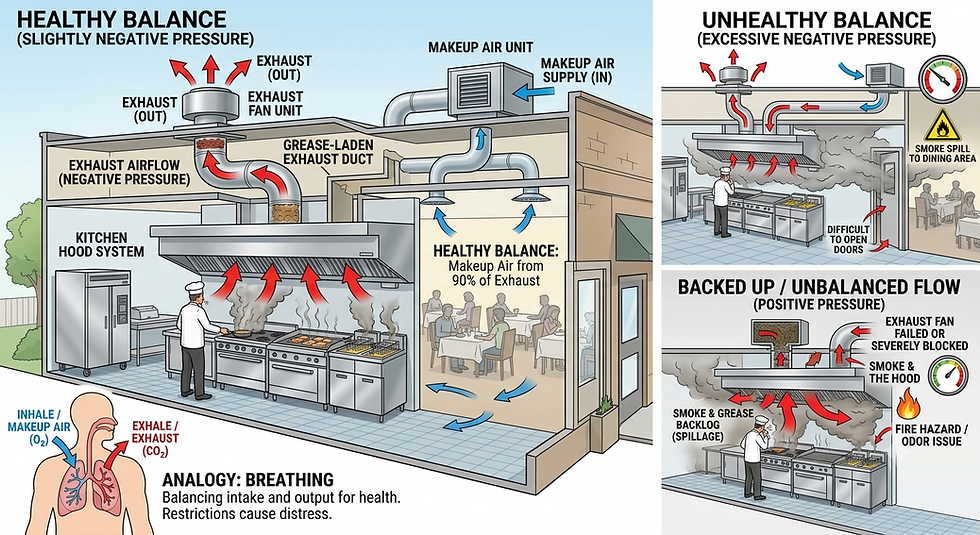
Negative Pressure (Suction): This is the fundamental job of the kitchen hood. When the powerful exhaust fan on the roof pulls air out through the ductwork, it creates a "negative zone" inside the kitchen. Since nature abhors a vacuum, air from surrounding areas (like the dining room) will try to rush in to fill that void. This suction is required to capture and remove the hot grease, smoke, and fumes generated by cooking equipment before they can spread.
Positive Pressure (Push): The kitchen cannot just exhaust air indefinitely without replacing it. A dedicated fan, called a Make-Up Air (MUA) unit, must actively pump fresh, tempered outdoor air into the kitchen. This supply of air creates "positive pressure" at its point of entry, balancing out what the hood is removing.
2. The Healthy Balance: Slightly Negative
The ideal state for any commercial kitchen is to be slightly negative relative to the adjacent dining areas.
A common target is for the make-up air to supply about 85% to 90% of the air that the hood exhausts. This small deficit ensures that there is always a gentle, consistent pull of air moving from the clean dining area into the busy kitchen, rather than the other way around. This guarantees that cooking odors, grease, and excess heat are contained entirely within the kitchen and effectively removed by the hood.
3. The Unhealthy Balances
When the system is not properly balanced, problems quickly arise:
Unhealthy Balance A: Excessively Negative (Too Little Make-Up Air)
If the hood exhausts 5,000 CFM (cubic feet per minute) but the make-up air unit is only supplying 1,000 CFM, the kitchen is starved for air.
Consequences:
Difficult Doors: The negative suction can make exterior doors or doors leading to the dining area incredibly hard to open.
"Whistling" or Drafts: Air will forcefully pull through any available crack, including window seals or electrical outlets, causing noisy drafts.
Backdrafting Fumes: This is critical. The powerful hood can actually reverse the flow of other gravity-vented appliances (like gas water heaters or furnaces), pulling dangerous combustion products (including Carbon Monoxide) back into the kitchen instead of letting them exhaust safely.
Unhealthy Balance B: Positive Kitchen (Too Much Make-Up Air or Failed Exhaust)
If the exhaust fan fails, or the make-up air is vastly overpowered, the kitchen becomes positively pressured.
Consequences:
Spillage: All the smoke, grease, heat, and intense cooking odors are pushed out of the kitchen area and spill directly into the dining room. This ruins the customer experience.
Nuisance Alarms: Smoke detectors in the dining area or other parts of the building can be triggered.
Inefficient Capture: The hood cannot do its job because the positive pressure is fighting the exhaust flow.
4. When the Airflow is "Backed Up"
Airflow becomes "backed up" when the path for the air is restricted or blocked. In a kitchen, this is almost always due to poor maintenance.
Grease Clogs: If the grease filters (seen in the inset diagram) are not cleaned daily, they become a solid wall of grease. This completely restricts the airflow the hood can pull, causing it to fail. The same applies to heavy grease buildup inside the ductwork.
Consequences:
Major Fire Hazard: A duct or filter clogged with grease is a bomb waiting for a spark.
System Overload: The fan motor will overwork trying to pull air through a blockage, leading to expensive motor failure.
Severe Air Quality Issues: All smoke and heat stay in the kitchen, making it an unbearable and unsafe environment for staff.
5. Analogy: Human Breathing
The kitchen ventilation system functions almost exactly like a steady, efficient cycle of human respiration, as shown in the small analogy diagram (image_0.png).
Exhaust (Exhaling): Just as you breathe out carbon dioxide (CO₂), the kitchen hood exhausts the contaminated cooking byproducts (smoke, grease, and heat). This is the "out" cycle.
Make-Up Air (Inhaling): Just as you must inhale fresh oxygen (O₂) to replace what you've breathed out, the building must bring in make-up air to replace what the hood removed. This is the "in" cycle.
Healthy Balance (Efficient Respiration): A steady, controlled rate of breathing keeps your body functioning optimally. Similarly, a properly balanced system (slightly negative kitchen) keeps the kitchen environment controlled, safe, and efficient, ensuring no smoke or odors disrupt the dining area. A blockage (like "backed up" airflow) is like having your airway restricted—the entire system fails.
Comments